

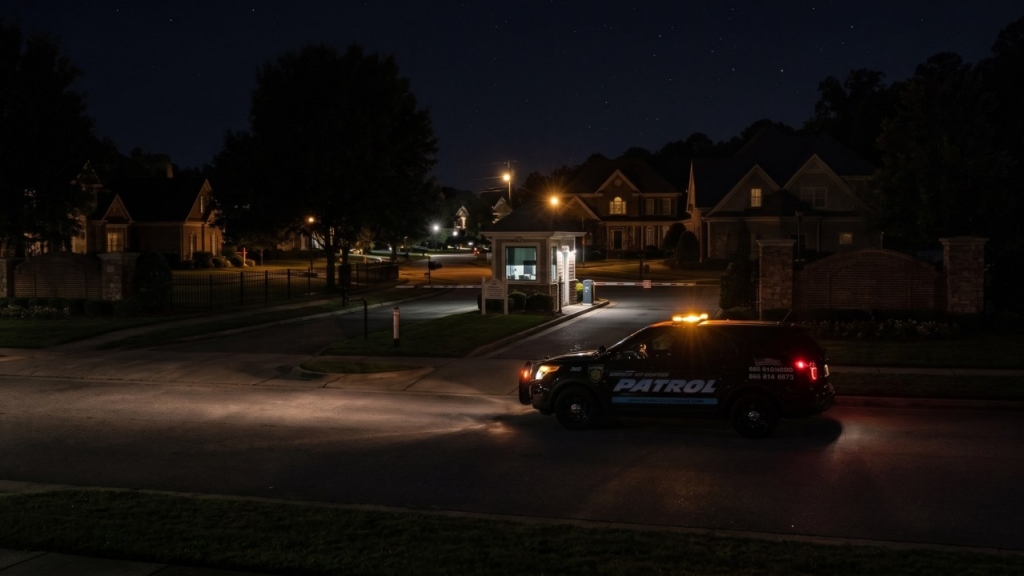
I talk with property managers and HOA boards across Orange County every week, and most of them have been burned by a security company at least once. Guards who didn’t show up. Reports that said nothing. A phone that nobody answered at night.
I’m Abe Momand, Director of Operations at Guards On Demand. We’re based in Fountain Valley and cover Orange, Los Angeles, Riverside, San Bernardino and San Diego counties. If I were the one signing a security contract for a community, these are the 10 questions I would ask first.
1. Is the company licensed and properly insured?
This is the easiest thing to check, and a lot of people skip it. Every security company in California needs a Private Patrol Operator (PPO) license from the Bureau of Security and Investigative Services (BSIS). Ask for the number, then look it up yourself on the BSIS website. It takes a couple of minutes and tells you if the license is active.
The officers need to be licensed too. Every guard on your property should have a valid guard card, and armed officers need extra permits on top of that.
Insurance matters just as much. Most security companies carry insurance, but make sure their coverage is appropriate for your site. Ask how much coverage they carry, and request a certificate of insurance for your property. While you’re at it, ask for proof of workers’ compensation and any other documents your board or management company requires. A reputable company will send these over without any trouble.
2. How do you hire and screen your officers?
A license is just the legal minimum. Ask what happens before someone is placed at your property. At Guards On Demand, every officer goes through an in-person interview and a background check first. We also test each officer on what they learned in their academy training, to make sure they actually retained it. Then they’re trained for the specific type of property they’ll be working, whether that’s an HOA, a hotel or a construction site. Any good company should be able to walk you through its hiring process without hesitating.
3. How will I know the officer actually showed up?
This is one of the most common complaints I hear. An officer shows up late or doesn’t show up at all, and nobody tells the manager. Ask if the company uses a check-in system that records when and where each officer clocks in and out. That way you have proof of coverage, not just someone’s word.
Other things to watch for are officers on their phones, officers who never get out of the car during a patrol, and anyone who looks checked out on post. Doing your own walk-through every so often is a good habit no matter who you hire.
4. What will my reports look like?
This is the number one reason managers switch companies. They are paying for patrols but can’t prove the patrols happened. A quick text saying everything is fine is not a report.
Here is what a good report should include:
- GPS tracking for every patrol, so you can see the officer was there
- Photos with the time, date and location at each checkpoint, like the pool gate, carports and entrances
- Detailed incident reports written by officers who are trained to document things properly
- A clean PDF sent to you daily or monthly, whichever you prefer
Good reports protect you too. If the board ever asks whether the community is getting what it pays for, you can show them.
5. Will we have the same officers, and will they know the property?
A new face every week is a problem. An officer who doesn’t know the property can’t spot what’s out of place. Ask if you’ll have consistent officers and how they get trained on your site.
When we take on a new property, our supervisors usually work the site themselves first. That way we know it firsthand, we can train each officer on what matters there, and we can fix problems quickly. We also use our interview process to match officers to the right property. Some officers are a better fit for certain types of sites than others, and the interview helps us find where each one will do their best work.
6. Who answers the phone at 2 a.m.?
This is the big one. If something happens in the middle of the night, you need a real person on the other end. More and more security companies now route calls through automated phone systems or AI dispatch, and I hear about it constantly from managers. When there’s an emergency at your property, the last thing you need is a recording. Ask if the company has 24/7 dispatch with live staff, not an automated line or a voicemail. There should also be a supervisor available around the clock who can make decisions and get someone moving.
7. What happens if an officer calls out or doesn’t show?
This can happen with any company. Someone gets sick, an emergency comes up and an officer has to leave, or an officer just doesn’t show. What matters is how the company handles it. Ask who covers the shift and how they get there.
We use roaming supervisors assigned to specific areas. For example, our Orange County supervisor checks on our sites throughout the day or night, depending on each property’s coverage. Because they’re already out in the field, the nearest supervisor can step in and cover the shift as quickly as possible.
8. Will management stay involved after we sign?
I hear this a lot. A company is very involved for the first few weeks, then it gets harder and harder to reach anyone. Ask who your main contact will be and how management steps in when something goes wrong.
A good security company knows that keeping a client is everything. It’s always harder to win a new contract than to keep the one you have, so management should stay closely involved for the life of the contract. That means having a team that handles issues quickly, with reports and time-stamped photos ready whenever you need them.
At Guards On Demand, we treat every property like our own. Each community we protect is like family to us, and nobody wants to let their family down.
9. How often are officers retrained?
California’s security laws change, and skills get rusty. Ask if officers get refresher training at least once or twice a year. Our officers are retrained by our own staff twice a year, on our company standards and current California law.
Guard cards also have to be renewed, which sends officers back for state-required training. A good company makes sure officers renew early and stay current, so nobody is ever working with an expired license.
On top of that, our in-house training prepares each officer for their specific site. That includes de-escalating situations without getting physical, arrest procedures under California law, maintaining a visible presence that deters problems, and stopping issues before they start.
10. Are we paying for the service or the name?
The big national companies have a lot of experience, and you usually pay extra for the name. Plenty of mid-sized companies deliver the same level of service for a better price. When an officer is alone on your property at night, the logo on the uniform isn’t what keeps it safe. Training, supervision and accountability are.
That said, don’t choose on price alone. Break-ins, damage and liability claims almost always cost more than good security does. Think of it as protecting your property and your residents. A lower rate is great, as long as you are still getting real service for it.
A real example
We recently started working with an Orange County HOA community that had been dealing with security problems for five years. The companies they had used were large, well-known providers with a lot of experience, and they were paying premium rates for it. Even so, the officers weren’t a good fit. Homeowners were frustrated, and the officers didn’t know how to handle the complaints. The company didn’t make any real changes, so the community kept switching providers. At one point they went through three companies in a single year.
A well-established company with a big name and big clients can charge a premium because of who they are. That doesn’t always mean the service on your property is better. We give our clients a fair rate that fits their budget, while still paying our officers properly so we can keep good people on every site. You don’t have to pay the highest rate to get excellent service.
When we came in, the first step was finding the actual problem. In this case it was access control. Officers were letting visitors and deliveries in without checking with residents first. We put a simple process in place: officers call the resident to confirm they’re expecting a visitor or delivery before anyone is let in. It sounds basic, but it made the community safer and gave the homeowners confidence again.
Most security companies offer the same core services. What sets one apart is management, the quality of its officers and its customer support. Every property has its own issues, whether it’s parking, controlling who comes in and out, trespassing or homelessness. A good company figures out what those issues are, communicates with the board and fixes problems quickly. That’s what you’re really hiring.
Want a second opinion on your current coverage?
If you manage an HOA or apartment community in Orange County, or anywhere in Los Angeles, Riverside, San Bernardino or San Diego counties, and want to talk through your current security coverage, feel free to reach out.
Abe Momand, Director of Operations, Guards On Demand, Inc.
BSIS PPO 120265 | (714) 851-8321 | guardsondemand.com
Leave a Reply